
Detect, Deter, Defend: Building Layered School Safety That Actually Works
Parkland wasn't a failure of the Second Amendment. Gun control wouldn't have saved Alaina. Sweden. Finland. China. School attacks happen everywhere — with or without gun control. The answer was never the gun. It was always the absence of a system to detect, deter & defend.


The Answer Isn't Gun Control. It Never Was.
Let's start somewhere the gun control crowd never wants to go: Sweden.
On March 4, 2025, a gunman walked into the Risbergska School in Örebro — 125 miles west of Stockholm — and killed ten people. Sweden. A country with some of the most restrictive firearms regulations in Europe. A country gun control advocates point to constantly as the model America should follow.
Tell that to the families in Örebro.
Or tell it to the families in Vantaa, Finland, where a 12-year-old opened fire at Viertola School in April 2024, killing one student and seriously wounding two others. According to John Lott's research at the Crime Prevention Research Center, Finland has a per capita rate of murder from mass public shootings up to 45 percent higher than the United States. Finland. A "peer nation." A gun control success story.
Or São Paulo, Brazil — stringent gun laws, March 2019 — where two attackers entered the Professor Raul Brasil State School and killed five students and two staff members before turning their weapons on themselves.
Or Mizhi County, China, where a 28-year-old former student murdered nine children and injured twelve more at a middle school. He used a knife. China has a near-total ban on civilian firearms. The children were just as dead.
I'm not cherry-picking. When Lott analyzed data from 89 countries, the United States ranked 58th in per capita mass shooting rates — and even lower for its murder rate. Countries like Finland, Norway, and Switzerland — the ones activists hold up as proof that gun control works — have higher per capita rates of murder from mass public shootings than we do. Some by nearly half.
These facts don't make the news. They don't fit the narrative. So they get ignored.
Here's the sleight of hand: when gun control advocates want to make a point about targeted school attacks, they switch the terminology to "gun homicide" or "mass shooting" — defined so broadly that the numbers swallow gang violence in a school parking lot after hours, shootings that occur off campus entirely, and any incident within a certain radius of a school building. Organizations like Everytown and the Gun Violence Archive source these inflated tallies from online news reports rather than law enforcement data, and they rarely revise their numbers when more accurate reporting becomes available. By the time actual law enforcement data is compiled, the political moment has passed and the false number is embedded in the public mind.
The point of all of this is not honest analysis. It's pressure — pressure on legislators to pass gun control measures that the international evidence tells us will not work. Shannon Watts tweets that America is "the only high-income country to have constant shootings on school grounds." Barack Obama said in 2015 that school attacks have "no parallel anywhere else in the world." These are not true statements. They are a political strategy. And every year we spend chasing that strategy is a year we are not building the systems that actually save children's lives.
I know something about what it costs to have the wrong conversation. My daughter Alaina was killed at Marjory Stoneman Douglas High School on February 14, 2018. She was fourteen years old, a Junior ROTC cadet, a kid who loved her country and had plans — big ones. That afternoon I got a call no parent should ever receive.
In the years since, I sat on the commission that investigated what happened. I worked with state and federal legislators. I went through Guardian training myself — all 144 hours — because I wanted to understand from the inside what we were building. And what I learned is this: Parkland was a failure of government. Failed detection, failed deterrence, and nobody on campus capable of stopping the attack in the minutes that mattered.
It was not a failure of the Second Amendment. It was not a problem gun control would have solved. The gun control debate consumed the weeks after Parkland, just as it consumes the weeks after every school attack. And while that debate rages, the actual work of protecting children goes undone.
That ends when we decide it ends. So let's talk about what actually works.
Detect: The Warning Signs Were Always There
Here is the first fact the gun control argument cannot survive: 93 percent of school attackers displayed observable warning behaviors before the attack — behaviors that others noticed.
Nine out of ten. Nearly every school attacker in America was showing the world that something was wrong before they ever pulled a trigger. They were not invisible. They were not unknowable. They were leaking. They were talking. They were planning. The people around them either didn't know what to look for, didn't know who to tell, or didn't believe it was serious enough to act on.
The U.S. Secret Service's National Threat Assessment Center has studied this since Columbine. Their 2021 report examined 67 school attack plots that were disrupted between 2006 and 2018. The numbers are striking and consistent: 76 percent of plotters communicated their intent to attack someone before the incident. An average of seven people knew something — and said nothing. Seventy-five percent of averted plots were detected because the plotter told someone their plans. Sixty-one percent of those reports came from peers — friends, classmates — not adults. Only 5 percent of school violence is truly impulsive. The other 95 percent is planned and, by definition, preventable.
The typical planning window runs eight to twelve weeks before an attack. Eight to twelve weeks of observable behavior. Eight to twelve weeks of opportunity to intervene — if we've built systems capable of catching it.
Researchers call it the pathway to violence. It moves from grievance or crisis — a breakup, a suspension, a public humiliation — through ideation, planning, and preparation, and finally to action. The Parkland attacker reportedly began his planning phase after a personal loss. That's a triggering event on a pathway that took months to reach its end. Months during which a functioning threat assessment system might have intersected his trajectory.
Florida recognized this and built the infrastructure to act on it. The Marjory Stoneman Douglas High School Public Safety Act required every district to establish a multi-disciplinary behavioral threat assessment team: educators, mental health professionals, law enforcement, and administrators working together using structured protocols to identify and respond to concerning behaviors before they escalate.
The law enforcement piece isn't optional, and it isn't ceremonial. In many districts across the country, educators alone are left to evaluate whether concerning behaviors rise to the level of criminal planning — an area in which they are not trained and should not be asked to operate alone. In Parkland, a threat assessment form was left incomplete by an administrator who didn't understand the process. That is a systems failure with fatal consequences. Law enforcement at the table changes that calculus.
By 2024, 85 percent of public schools nationwide had behavioral threat assessment teams in place. That's real progress. But 15 percent still don't. And a team on paper is not the same as one that functions — one that meets regularly, applies structured protocols, and has law enforcement fully integrated at every stage.
Detection is layer one. Knowing someone is on a pathway to violence is the foundation. But it's meaningless if your school is easy to access and impossible to defend once that pathway reaches your front door.
Deter: Smart Security Isn't a Prison
I hear the objection before anyone raises it. Nobody wants their child going to school in a fortress. Metal detectors at every door, armed guards in every hallway — that's not a school, it's a trauma. I agree. I've never advocated for that, and neither does the evidence.
Smart physical security done right is largely invisible to the students inside. What it does is deny easy access to a threat while preserving a normal learning environment. Think about how your bank works. When you walk in, you don't feel like you're in a prison. But there are layers of security you move through without noticing — controlled access, sightlines designed to eliminate blind spots, physical barriers built into the architecture, staff trained to recognize and respond to threats. We built those systems intentionally because we took our money seriously enough to protect it.
Our children deserve at least that much.
The core elements are not complicated or expensive: a single controlled point of entry during school hours, so visitors are channeled through one location where they can be observed and vetted. A controlled access vestibule — an airlock-style double-door entry where a visitor is verified before gaining access to the building. This creates delay. And delay is what saves lives when an armed response is needed. Classroom doors that lock from the inside, so teachers don't have to step out into danger to secure their students. Perimeter control with fencing, cameras, and clear sightlines that eliminate hiding spots and force any approach to the building into the open.
Here's the data point that matters most for the deterrence argument: attackers do target selection. The Covenant School shooter in Nashville had considered Opry Mills Mall as an alternate target. She rejected it because of the security presence there. She chose the school because the children — in her own assessment — wouldn't put up a fight. In 19 percent of studied attack plots, nearly one in five, plotters specifically targeted or tried to neutralize security measures. They planned around SROs. They looked for unmonitored entry points. They were performing their own vulnerability assessments.
That is the attacker telling us directly that hardening works. When they're changing their target because of security, when they're spending planning time trying to account for physical barriers — that's confirmation. The people we're trying to stop are telling us with their own behavior that security creates real deterrence.
Defend: The Math That Doesn't Lie
Here is the hardest truth in this entire conversation.
The average duration of an active shooter incident in a school is three to five minutes. The average law enforcement response time after a 911 call is seven to ten minutes. The outcome — who lives and who dies — is almost entirely determined before the first patrol car arrives.
I know this more personally than I'd ever want to. The shooter at Marjory Stoneman Douglas killed seventeen people in approximately six minutes. By the time law enforcement rallied, the math had already done its terrible work. This is not a criticism of law enforcement. With few exceptions (a big exception was former Deputy Scot Peterson, who hid behind a cement barrier for 48 minutes during the Parkland attack), these men and women respond as fast as physics allows. It is simply a recognition that geography creates a window — and when there is no trained response already on site, that window is lethal.
School Resource Officers are the first answer. An SRO is a sworn, commissioned law enforcement officer — a fully trained cop — assigned to a school as their primary duty. They carry the same equipment as any officer on patrol. They have arrest authority and tactical training. And the NTAC data makes their preventive value explicit: in nearly one-third of averted school attack plots, an SRO played a role in either reporting the plot or responding to a report someone else brought forward.
That's the part people miss. SROs don't just respond to attacks in progress — they're embedded in the school culture in ways that make them effective in the detection layer too. Students talk to them. Teachers trust them. They know kids by name, know when something is off. SRO programs not an everyday expense. They are an investment with lifesaving returns.
But Florida didn't stop with SROs. Because in a state with thousands of school campuses, you cannot put a sworn officer everywhere. That's reality.
That's why the Guardian Program exists. Screened, volunteer school employees — coaches, administrators, teachers — who pass background checks, drug testing, and psychological evaluation, then complete 144 hours of training: 132 hours of firearm safety and proficiency, plus 12 hours of de-escalation. This is not someone with a carry permit walking through a door. This is a trained, vetted, practiced defender already embedded in the school community — who knows the building, knows the students, and has trained alongside law enforcement with a coordinated response plan.
And here is what makes the Guardian Program particularly effective as a deterrent: the attacker doesn't know who they are. You can plan around an SRO you can see. You cannot plan around an assistant principal or a coach whose training is not publicly disclosed. That uncertainty is itself a weapon — and we know it works, because would-be attackers have said so. Interviewed subjects have cited the unknown presence of armed staff as a reason they reconsidered.
I am an honorary Guardian. I went through the training. What I came away with was not just confidence in the program — it was respect for every person who raises their hand and says: I will be the one who stands between these kids and the worst day of their lives.
Critics call this putting guns in schools. I'd ask those critics — again — to explain Örebro. To explain Mizhi County. Because those children were protected by exactly the gun control policies the critics are demanding. And they were just as dead. The problem was never the gun. The problem was the absence of anyone capable of stopping the attack in the minutes that mattered.
What It Takes to Build This Everywhere
In Tallahassee, weeks after Alaina was killed — almost before we had a chance to lay her to rest — I stood in front of the Florida House and Senate and said: "If this evolves into a gun control debate, we are going to miss our opportunity to get something done."
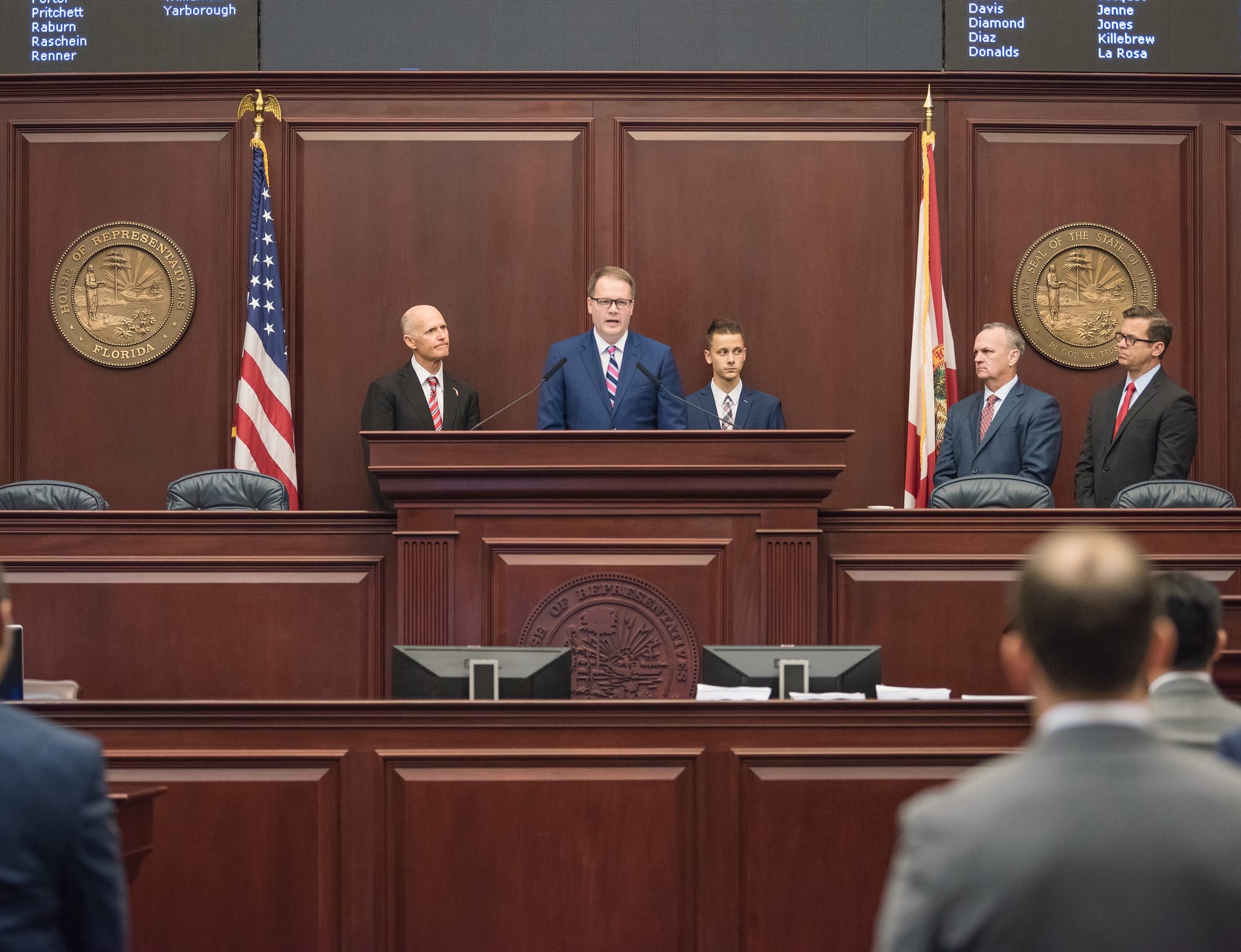
Seven years later, I'll say it again. Louder.
The gun rights debate is a separate conversation, and an important one. But it is not the school safety conversation. They don't have to be in conflict. The Second Amendment is not the obstacle here — in Florida, through the Guardian Program, it is part of the solution. Trained, vetted, constitutionally-grounded defenders standing between our children and violence. The same principles the Founders understood — that an armed citizenry can provide for its own defense — applied to the modern challenge of keeping kids safe.
What stands between us and building this everywhere isn't a lack of evidence. The evidence is overwhelming. NTAC has given us the roadmap. Florida has proven the model. The international data has demolished the myth that gun control is the answer. What stands between us and building this everywhere is the willingness to stop having the wrong argument.
We secure our banks. We secure our airports. We put armed guards in front of courthouses and government buildings. And for too long, we sent our most precious people — our children — into buildings we labeled "gun-free zones" and called it a safety policy. The bitter irony of that ought to keep every school board member in this country awake at night.
So here is what I'm asking. Find out whether your school has a behavioral threat assessment team with law enforcement at the table — not just on paper, but functioning. Find out whether there is a trained, armed presence on campus during school hours and at every school activity. Find out whether your state has a Guardian-style program, and if it does, whether your district participates.
If the answers are no, ask why. Then show up at a school board meeting and demand better. Engage your state legislature. Support candidates who take school safety seriously as a layered, evidence-based commitment — not as a talking point.
Alaina was the kind of kid who understood why hard things matter. She wore a uniform to school because she believed in service and sacrifice. She would have been embarrassed to know I was up here talking about her — and she would have understood exactly why I am.
This is the hard thing. Building these systems, fighting through the political noise to focus on what actually protects children — it's hard. But they're worth it.
Detect. Deter. Defend.
Not a slogan. A system. And our kids deserve to have it built everywhere.


