
Florida Just Extended School Safety to Higher Ed. The Rest of the Country Has No Excuse.
HB 757 takes the layered school safety model Florida built in K-12 and applies it where the evidence says we need it next — on college and university campuses. It should be a national template.

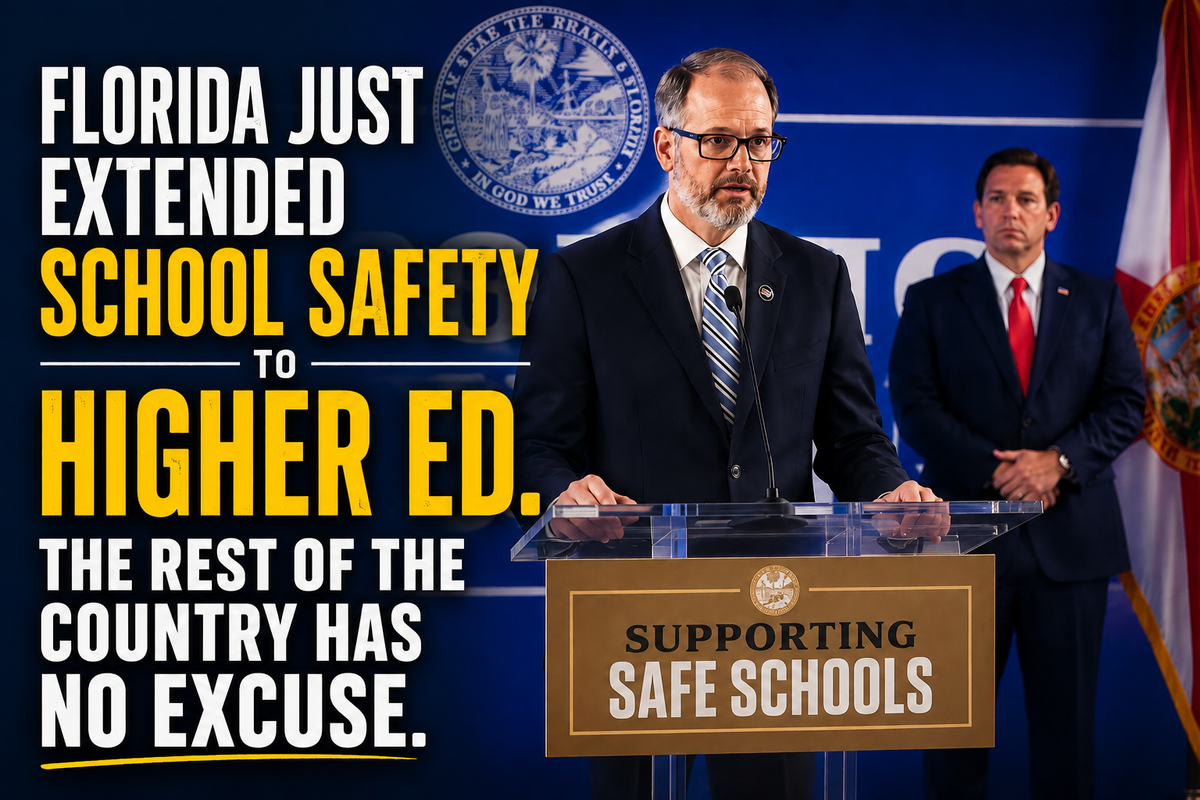
On May 15, 2026, Governor Ron DeSantis signed House Bill 757 at the 5th Annual Commissioner's Summit on School Safety in Miami. The bill extends the Chris Hixon, Coach Aaron Feis, and Coach Scott Beigel Guardian Program to Florida's public colleges and universities. It requires postsecondary institutions to develop assailant response plans, build threat management teams, and create family reunification procedures. It makes discharging a firearm within 1,000 feet of a school a second-degree felony.
These are not abstract reforms. Each one closes a specific gap that existed on every Florida college campus until last week.
I know they were gaps. The conversation about closing them was already underway when, on April 17, 2025, a 20-year-old (I will not name him here) — newly transferred to Florida State University from Tallahassee State College — walked onto the FSU campus with a handgun stolen from his stepmother, a Leon County sheriff's deputy. He killed Robert Morales, 57, the FSU campus dining director and an assistant football coach at Leon High School in Tallahassee. He killed Tiru Chabba, 45, an Aramark regional vice president who was on campus serving the institution. He wounded six more by gunfire. Officers reached him in roughly four minutes, and an FSU police officer named Cody Poppell — riding a motorcycle toward the sound of gunfire — shot the attacker in the jaw before he could kill again.
Four minutes is fast. Four minutes is heroic. And four minutes was long enough for two men to die.
Five days before HB 757 was signed, the State of Florida awarded Officer Poppell the newly-created Moment of Valor commendation. FSU Police Chief Jason Trumbower described what Poppell did in plain terms: "Amid the chaos, Officer Poppell acted swiftly, rode his motorcycle over several curbs, sidewalks, into the heart of our campus and confronted the threat head on without really ever dismounting off of his motorcycle." The grand jury that indicted the attacker put it more directly: "There is no question others would have died absent his actions." The state created a new award because no existing one captured what one officer did with three minutes and a motorcycle. That is what the response side of the equation can look like. HB 757 is about ensuring it is not the only side of the equation.
Weeks later, at the invitation of then-Commissioner Manny Diaz Jr., I sat down with Florida's college presidents and the State University System Board of Governors. The meeting had been in motion before FSU. After FSU, it had a different weight. We had a tough, but encouraging conversation about the threats their institutions face and the very different way their schools operate — open, sprawling, transient populations, no single point of access. None of that changes the math of an active shooter incident. None of that changes the pathway to violence. Their students are no less targeted, and no less vulnerable, than the seventeen-year-old senior in a high school across town.
The gaps had to close. Thirteen months after that meeting, HB 757 closed them.
The Pathway to Violence Doesn't Care About Graduation
The U.S. Secret Service's National Threat Assessment Center has been telling us for years what targeted attackers do before they attack. Ninety-three percent display observable warning behaviors. Seventy-six percent communicate their intent to someone. An average of seven people know something — and say nothing. Only five percent of school attacks are truly impulsive. The other ninety-five percent are planned, often over an eight-to-twelve-week window, and by definition, preventable — if a system exists to catch them.
That system exists in Florida K-12. Every district has a multi-disciplinary behavioral threat assessment team — educators, mental health professionals, law enforcement, and administrators meeting regularly to identify concerning behaviors before they reach the end of the pathway. Eighty-five percent of public schools nationwide have something similar in place. It works.
It did not exist at Tallahassee State College, where the attacker had been taking classes. It did not exist at Florida State University on April 17, 2025. It did not exist on a single public college or university campus in this state.
That was the gap. HB 757 closes it.
The Guardian Program Was Named for a Reason
The Guardian Program carries three names that should be spoken every time it is invoked. Chris Hixon, athletic director. Aaron Feis, assistant football coach. Scott Beigel, geography teacher. None of them were armed. All of them died on February 14, 2018, trying to shield students with their bodies.
The program asks the question their deaths raised: what if these men had been trained, vetted, and equipped to do what they were already willing to do unarmed?
In Florida K-12, the answer is now operational. Volunteer school employees who pass a background check, drug testing, and psychological evaluation complete 144 hours of training — 132 hours of firearms proficiency and 12 hours of de-escalation — before they ever step onto a campus as a guardian. That training is among the most rigorous in the country, exceeding what is required of many sworn law enforcement officers. Guardians are screened, embedded defenders who know the campus, know the community, and have trained with local law enforcement on a coordinated response plan.
The program works in part because it creates an unknown-armed-presence deterrent — attackers cannot plan around a defender they cannot identify. The Covenant School shooter in Nashville rejected an alternate target because of visible security. NTAC data shows nineteen percent of studied attack plotters specifically targeted or tried to neutralize security measures. They are telling us, through their own behavior, that hardening deters.
HB 757 extends the program's namesakes' protection to Florida's public colleges and universities on a voluntary, institution-by-institution basis. The screening and training requirements remain the same. The model that has worked for seven years in K-12 is now available where, until last week, it was prohibited.
The Other Provisions Matter Just as Much
The Guardian expansion got the headlines. The rest of HB 757 may matter even more.
Postsecondary institutions are now required to develop assailant response plans. They are required to establish threat management teams. They are required to create family reunification procedures so that on the worst day, parents are not searching parking lots and hospital waiting rooms for information about whether their child is alive.
These are the operational systems that should have existed already. They didn't. Now, in Florida, they will.
The 1,000-foot felony enhancement closes another gap. Discharging a firearm in the immediate vicinity of a school is the kind of offense the law should treat as categorically different from a random act of violence anywhere else. It now does.
What Comes Next
I'm grateful to the legislators who carried HB 757, to Commissioner Stasi Kamoutsas for hosting the summit where it was signed, and to Governor DeSantis for continuing the eight-year arc of school safety reform that began after Parkland. I'm also grateful to Manny Diaz Jr., who convened the meeting that mattered, and who served Florida's students with distinction.
I am not finished asking. HB 757 is a first step. The same model should now extend to Florida's private postsecondary institutions, to every K-12 charter school, and to every soft-target gathering place where our most precious people are concentrated and currently undefended. Every other state should look at what Florida built — eight years of measured implementation, refinement, and investment, scaled across forty million people and thousands of public schools and dozens of universities — and stop pretending the model is untested or politically impossible.
If you are a parent of a college student in Florida, find out whether your school has signed onto the Guardian Program. Find out whether it has a functioning threat management team. Find out whether it has an assailant response plan its faculty have actually trained on, or one that exists only on paper.
If the answers are no, ask why. Then show up at a board meeting and demand better.
The conversation that began before FSU and sharpened after it has now reached its first real outcome. The next gaps won't close themselves.


